150 Years of the Bayreuth Festival
The Bayreuth Festival, renowned for its dedication to the works of Richard Wagner, marks its 150th anniversary on July 25, 2026. This milestone, however, is accompanied by ongoing discussions regarding the festival's historical connections to antisemitism and the Nazi regime.
Controversy Surrounding the Festival
Jewish public intellectual Michel Friedman was initially invited to speak at a memorial event for victims of National Socialism during the festival's opening. His planned discussion on Wagner's antisemitism and the festival's Nazi-era links led to his disinvitation, which was later reversed following public criticism. The German newspaper Süddeutsche Zeitung criticized this episode as indicative of a broader reluctance within Germany to confront its historical past.
Anno Mungen, head of the Research Institute for Music Theater Studies at the University of Bayreuth, has voiced concerns about the festival's leadership. In a Die Zeit interview, he accused the organizers of being historically negligent, highlighting the inclusion of Wagner's opera "Rienzi"—a favorite of Adolf Hitler—during the anniversary celebrations.
Richard Wagner's Influence
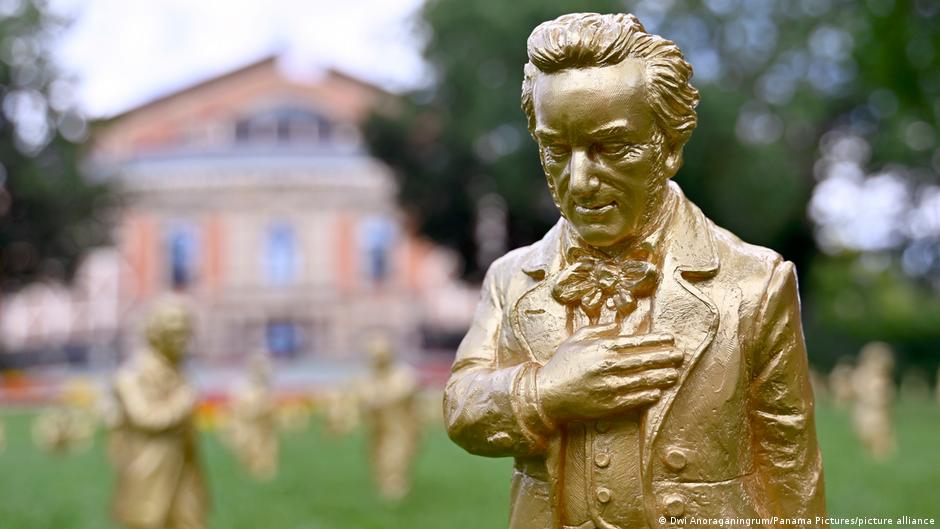
Richard Wagner, a revolutionary composer, also held antisemitic views. His operas, which he envisioned as Gesamtkunstwerke—comprehensive works of art—became a unique hallmark of the Bayreuth Festival. Wagner's operas, many inspired by Germanic and Norse mythology, continue to draw international audiences to the festival's original venue, the Bayreuth Festspielhaus.
Despite its historical associations and lack of modern comforts, the festival remains a pilgrimage for Wagner enthusiasts. The Festspielhaus, designed by Wagner, offers a distinctive experience with its acoustics and staging, which includes an orchestra hidden beneath the stage and performers illuminated against a darkened audience.
Wagner's Legacy and the Nazi Regime
Long after Wagner's death, his works captivated Adolf Hitler, who admired the dramatic elements and themes of power in Wagner's operas, particularly "Rienzi." Wagner's music was later appropriated as a propaganda tool by the Nazi regime and used during significant events like the Nuremberg Party Rally.
The festival's association with Nazism has been a shadow over its history, compounded by Wagner's own antisemitism detailed in his 1850 essay "Judaism in Music." This legacy influenced subsequent generations of the Wagner family, including their interactions with Hitler, who frequented their Bayreuth home.
Post-War Transformation of the Festival
Following World War II, the festival underwent denazification. Winifred Wagner transferred her rights to her sons, Wieland and Wolfgang Wagner, to dissociate the festival from its Nazi ties. Wieland's minimalist productions redefined the festival's artistic approach, creating the "New Bayreuth" style.
Wolfgang Wagner later expanded the festival's artistic horizons by inviting external directors, thus broadening its stylistic range.
Modernizing the Bayreuth Festival
Today, under the leadership of Katharina Wagner, the festival seeks to adapt to contemporary times. Recent productions have incorporated innovative elements like augmented reality and artificial intelligence. In 2022, a new interpretation of "The Ring" was presented as a modern family saga, and in 2023, "Parsifal" incorporated digital effects.
The upcoming "Rienzi" production, directed by Alexandra Szemeredy and Magdolna Parditka, is anticipated to reframe the opera as a courtroom drama with modern societal parallels. Additionally, the festival will feature music by Jewish composers alongside Michel Friedman's lecture.
Source: Original Article